Designing Tremendous’s flagship fraud prevention system
- Company

- Year
- 2024
- Duration
- 7 weeks
- My Role
- Sole designer
- Team
- PM + Sales team
Tremendous’s customers were losing money to people claiming rewards they hadn’t earned, but they wouldn’t trust a tool that might block their real recipients. As the project’s sole designer, I designed a fraud prevention system customers stay in control of: rules they set themselves, and a review queue where a person makes the final call. It blocked over $100K in fraud in its first 3 months of beta, and became the center of the sales pitch.
Challenge
Tremendous needed a stronger differentiator. Meanwhile, sales prospects needed an end to fraudulent reward redemptions.
Tremendous is a rewards and payout platform. At the time of this project, Tremendous had one of the strongest rewards offerings but was struggling to win prospects who had no strong reason to switch. Migrating to a new money-related tool can be a painful and drawn-out process.
But there was a clear, unserved market opportunity: fraud protection. Companies were losing millions of dollars to fraudulently claimed rewards, and no competitor offered a built-in fraud prevention tool. I was asked to design the interface for the AI-powered tool that would become Tremendous’s biggest differentiator.
Insights
Customers wanted help spotting fraud, without losing speed or the final say.
Here’s what we heard from prospects and customers through the sales team:
- “Suspicious” is subjective. What looks like fraud for one company might be completely normal for another. Each customer needed to be able to configure their own flag, block and allow rules.
- Volume is often high. Some customers sent thousands of rewards in a single day. The ideal solution would be scannable, and allow for bulk interactions without compromising accuracy.
- Rewards equal reputation. A Tremendous transaction might represent a thank you for research participation, a class action win, or recognition of an all-star employee. Wrongly blocking a real participant from redeeming one of these rewards could cost teams far more than money, which explained customers’ hesitation to adopt something fully automated.
“These users have invested time and effort. At the end of this journey, if we say ‘you’re disqualified, we aren’t paying you out,’ we better be confident in that.”
Approach
The Goldilocks moments of a human-in-the-loop system
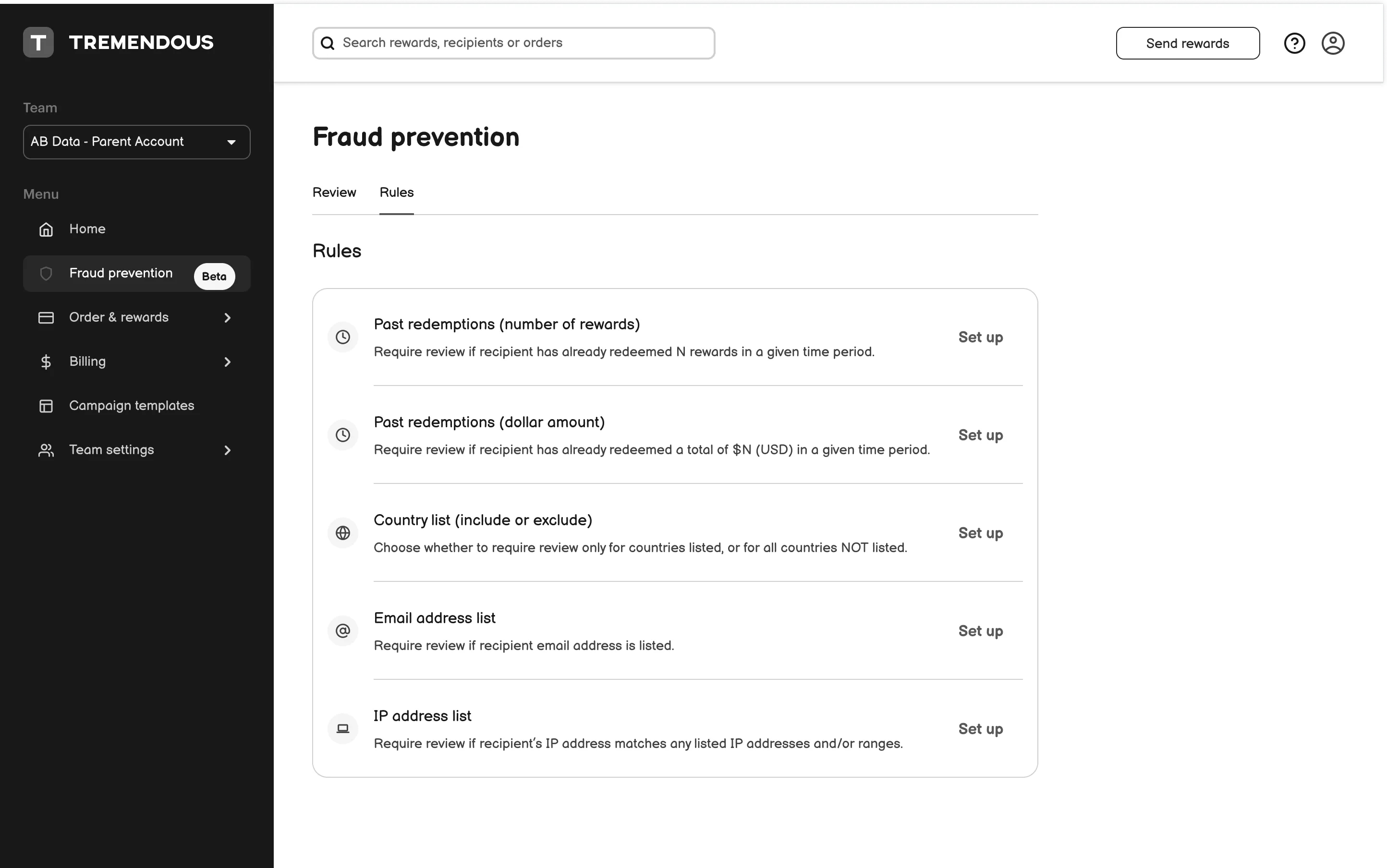
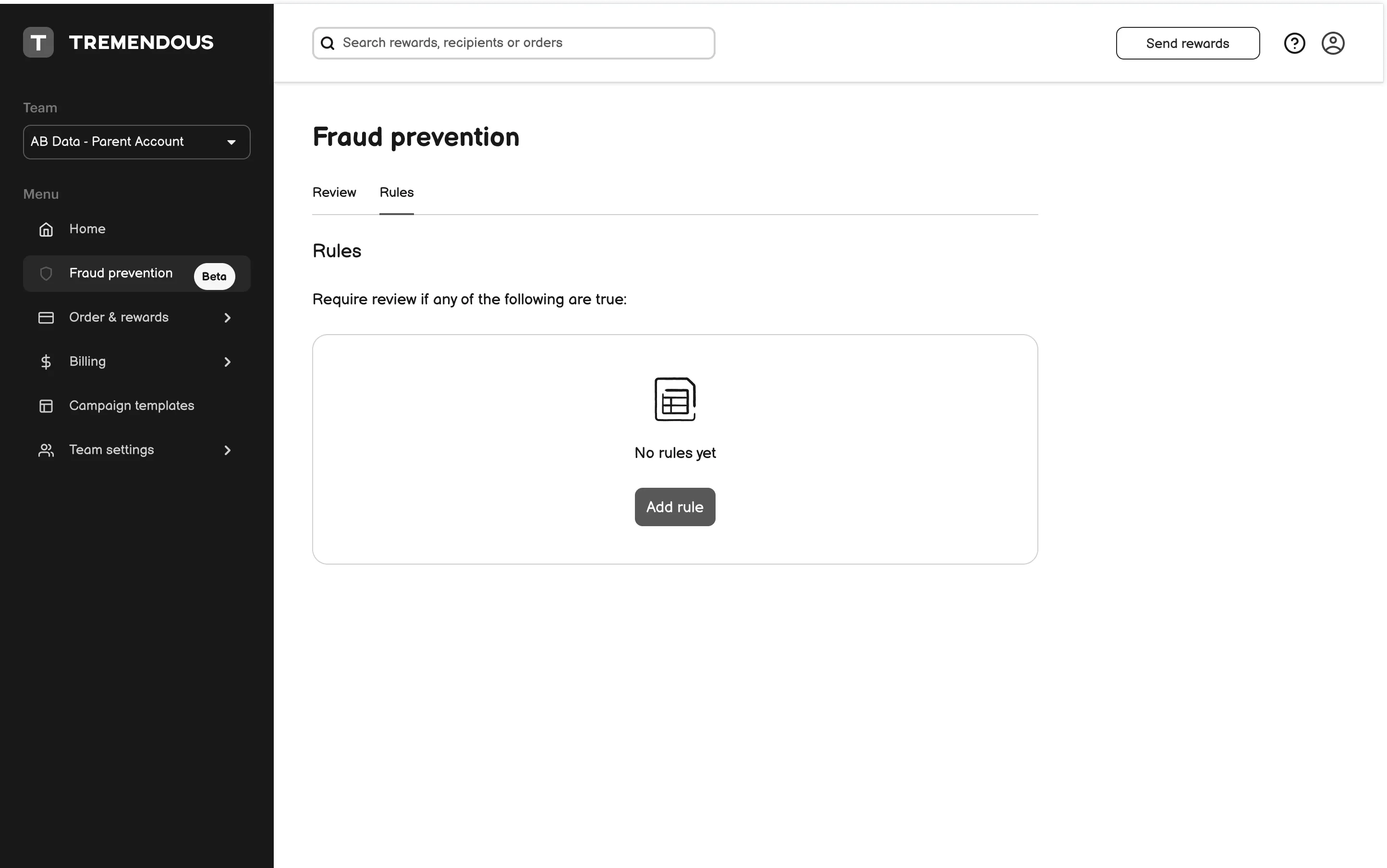
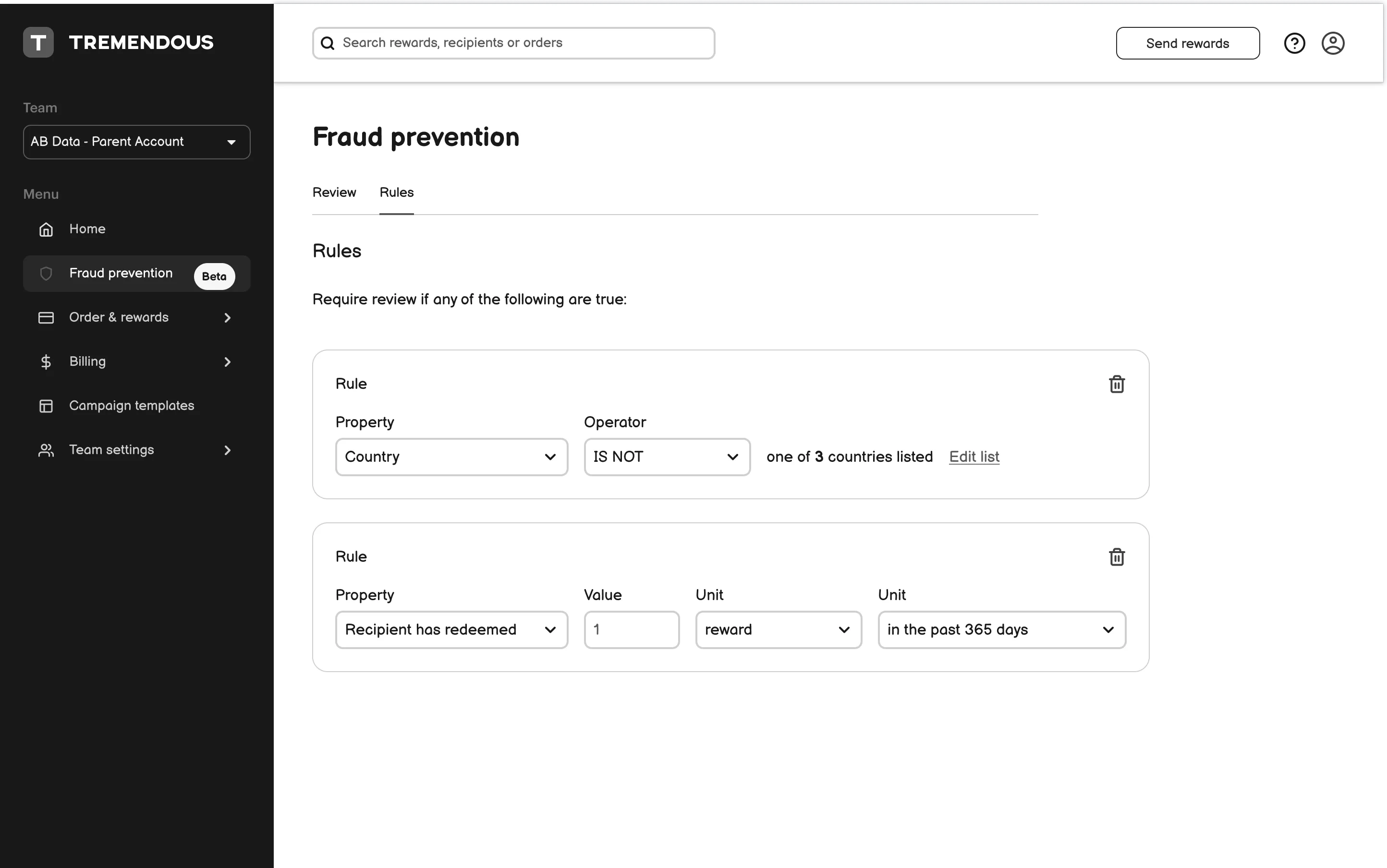
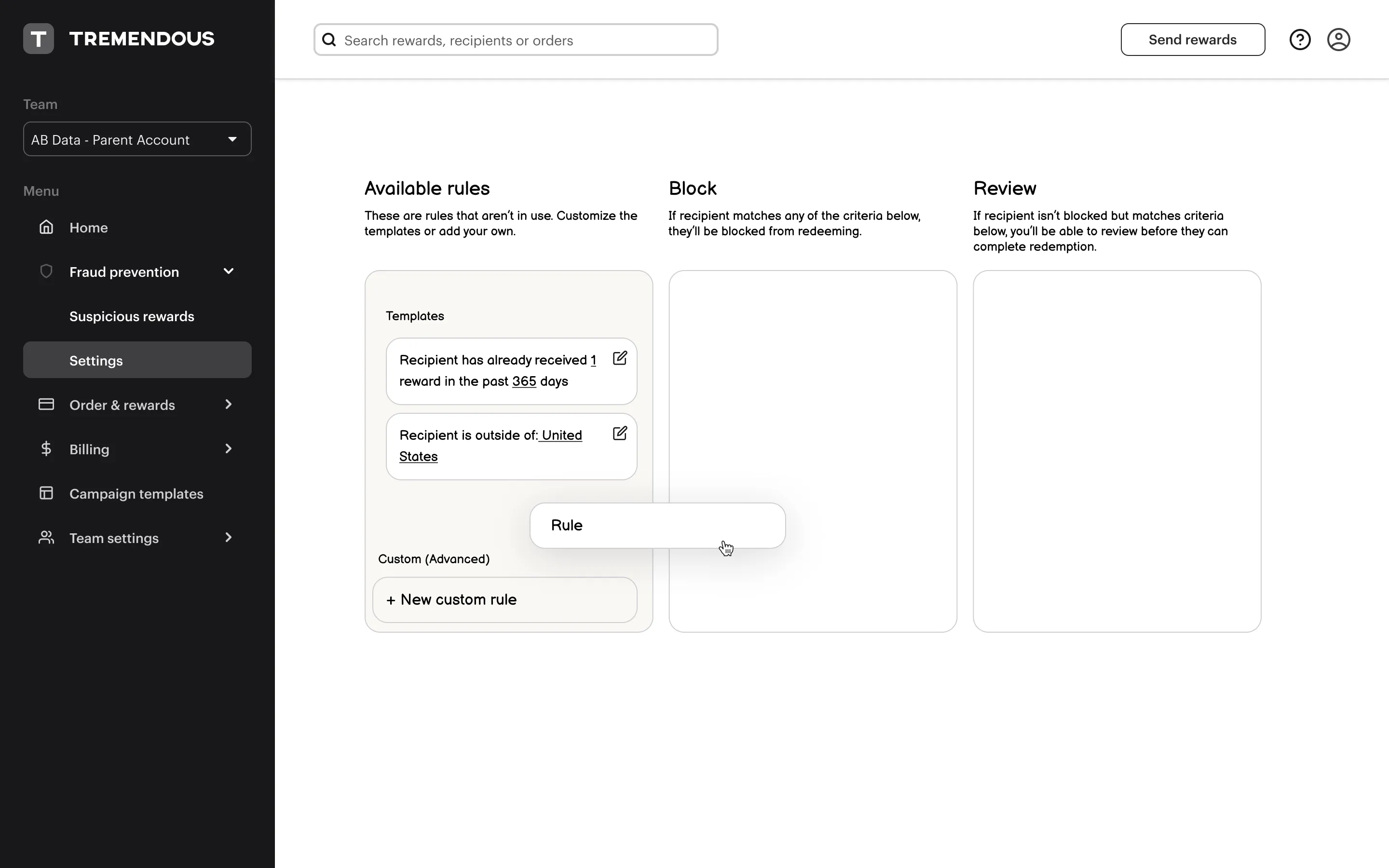
Rule setup: Establishing guardrails
Allowing users to write complex Boolean operators might offer a sense of freedom, but also lead to more human error that might then be blamed on “the algorithm.” On the other hand, obscuring details too much wouldn’t help us build the trust we were missing. The winning solution was a categorical breakdown of options, each with its own subpage that tailored inputs towards error prevention.
Transaction review: Progressive disclosure
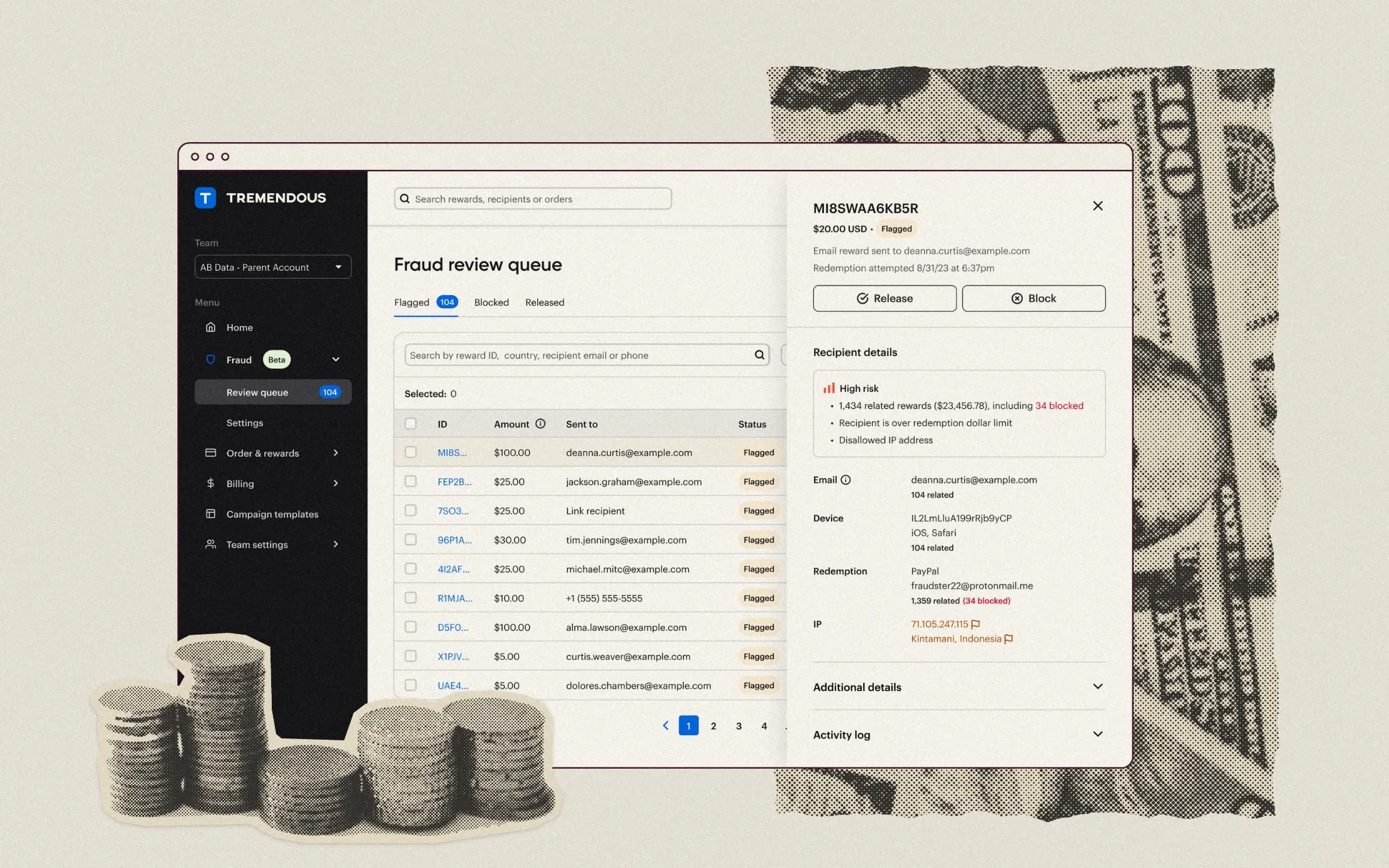
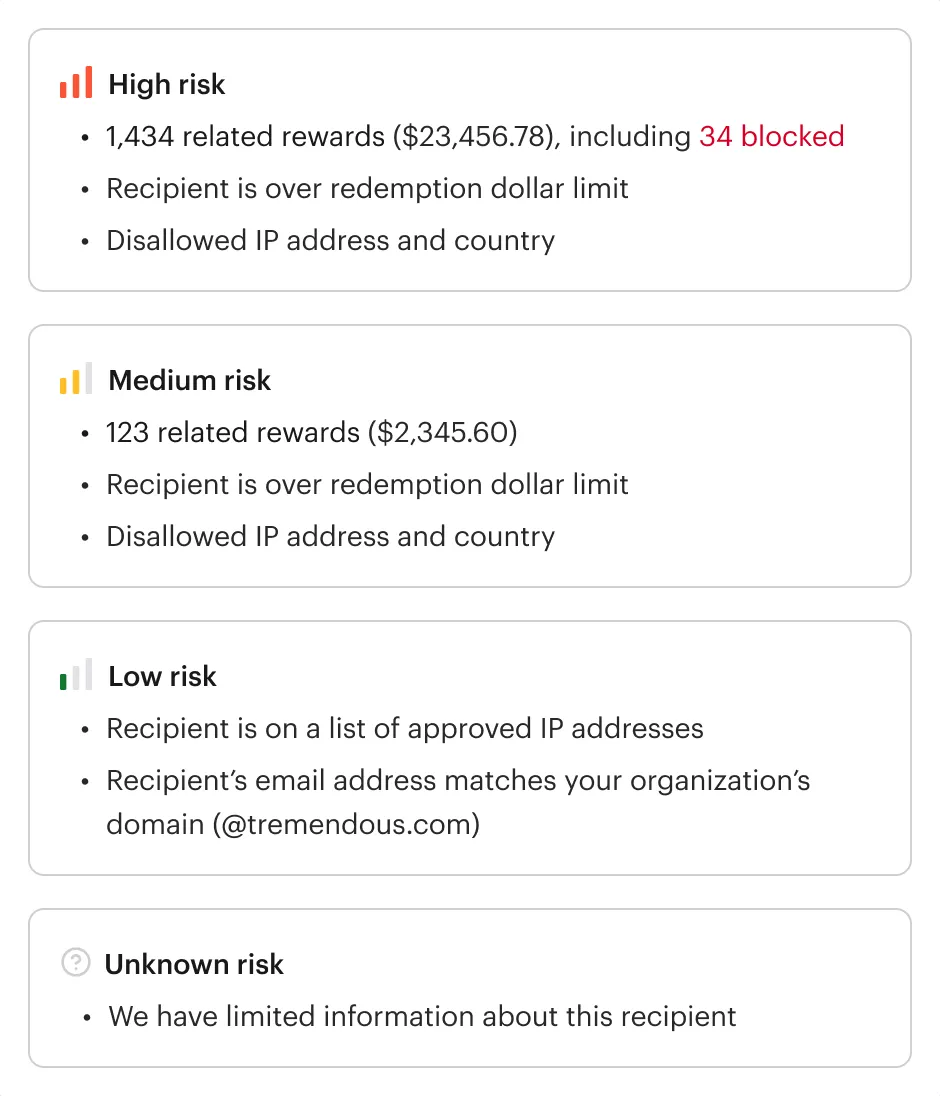
As the data set of fraudulent transactions grew, we’d eventually be able to expand the list of criteria to flag. And the longer the list of criteria met by a single transaction, the more cognitive load it would take to review. To keep reviews fast as the criteria grew, I designed a risk score: a single signal users could scan quickly and learn to trust over time.
The messy bits
I proposed an additive pattern early on, and we soon outgrew the alternative.
During early wireframing, I proposed an additive pattern for rule creation – starting from an empty state and adding rules from a menu, rather than showing a pre-populated list of every rule on the main page. My argument was that separating active rules from rule browsing would reduce cognitive load as the feature scaled.
The team pointed out that the pre-populated list was stronger for feature discovery, so we tried that first. But shortly after the beta, the list of available rules had already grown, and the all-in-one display was harder to parse without some form of progressive disclosure. After I’d moved on from the project, the team switched to the additive pattern.
Final solution
Stopping fraud without blocking the rewards real people earned.
From Tremendous’s launch video.
If you’d like a closer look, I’ve recreated the basics in an interactive prototype below. Try setting up flag rules, then release or block flagged rewards.
Impact
Tremendous’s fraud tool blocked over $100K in fraudulent rewards in the first 3 months of beta.
In the year following the beta launch, the company’s revenue nearly doubled, with fraud prevention at the center of the sales pitch.
TecHR · April 2024 · 3 min readTremendous fills industry void with new fraud prevention tool (opens in a new tab)Reflection
There’s a balance between full control and full automation, and the key variable is trust.
This was my first time shipping an AI-powered feature, and it confirmed what I already suspected: the tool only works if customers trust it. Fraud prevention worked because we kept a person in control at the two moments where a wrong call cost the most: deciding what counts as suspicious, and deciding what happens to someone’s reward.
Ironically, I missed a chance to build trust within the team. When we disagreed about rule setup, I could’ve run a quick test with a handful of customers and settled the debate with real evidence, instead of waiting for the beta to settle it for us.
Read Next:
Leading DoorDash’s menu editor from vision to redesign
A mobile-first, self-serve menu editor that lets merchants build complex menus themselves.

Redesigning Mastodon’s web app to make a complex platform feel approachable
A new design system and web redesign that make Mastodon easier to learn, and the foundation for its iOS and Android apps.